Centralize requests, processing and follow-up in one workflow adapted to your business.
Integration with your existing website or a complete turnkey solution.
Direct contact is available through Telegram, WhatsApp or email.
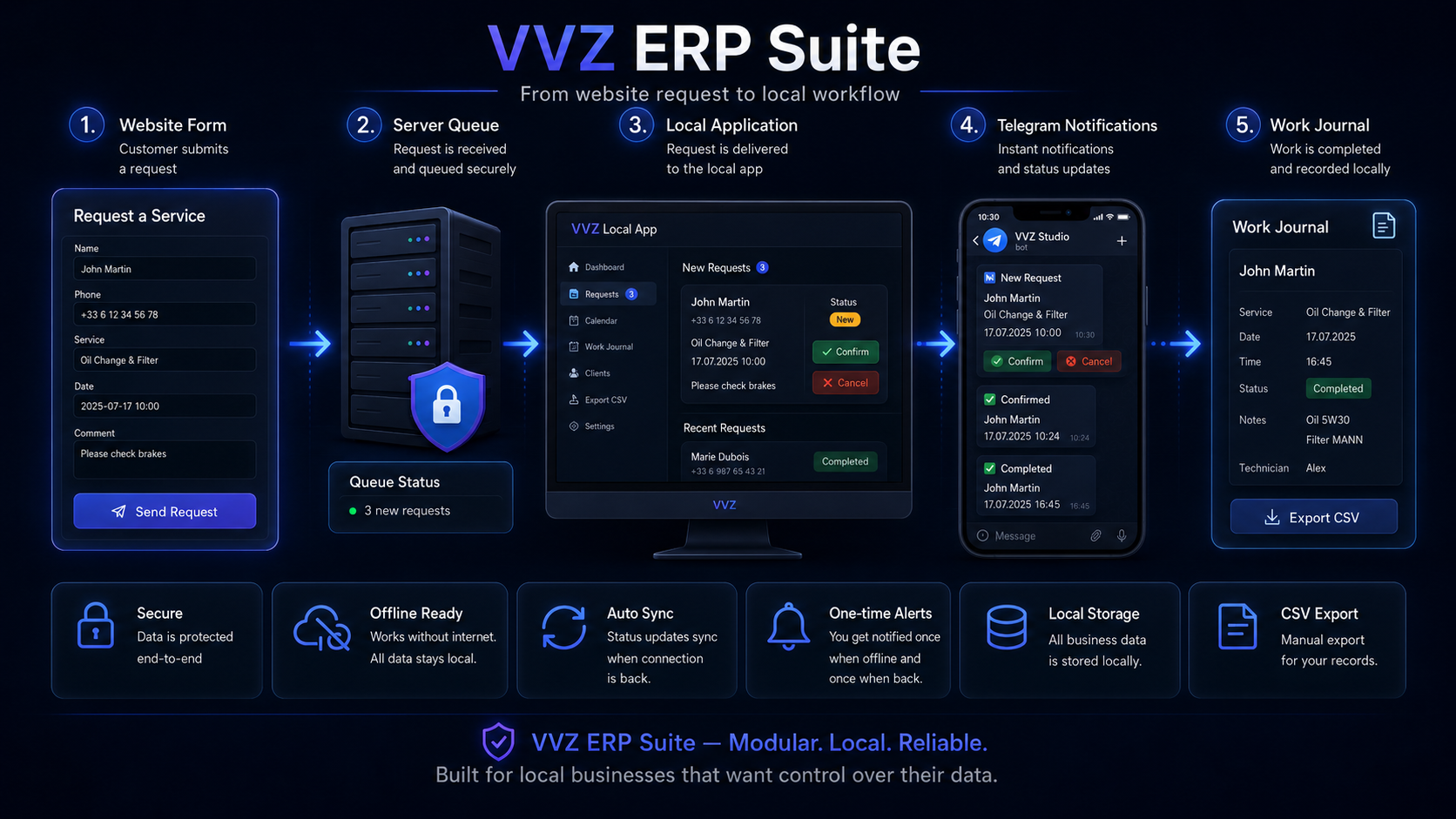
One connected workflow moves a request from the website to the local work journal without presenting separate products.
The customer sends a request through the website form with the details needed for processing.
The server validates the request and places it in the queue for delivery to the business.
The local application receives the request, creates the working record and stores the main operational data.
The authorized master receives a notification and can confirm or cancel the request when that action is enabled.
After the work, the request is marked completed or cancelled in the workflow.
The local journal keeps the operational record, and data can be exported manually to CSV when needed.
The same reusable engine is configured for the client’s business instead of being rebuilt from zero for each project.
Connect request intake and server delivery to the current website after reviewing its structure and safe integration options.
Prepare the website, server, local application, Telegram connection and selected business modules as one working system.
Add a module or workflow connection adapted to an existing operating process when the ready engine needs an extension.
We clarify how requests arrive, what data is required and which statuses the business actually uses.
The ready engine, dictionaries, modules and business rules are configured for the selected activity.
The full chain is checked from website request to local processing, Telegram action and manual CSV export.
VVZ ERP Suite keeps the main working data close to the business while using the server and Telegram for delivery and control.
Primary business data and the work journal are kept in the local application.
The server stores only what is needed to receive, deliver and synchronize requests.
Telegram sends notifications and authorized actions; it is not the database.
The local application must show connection loss, last successful synchronization and pending queued items.
Status updates and pending actions can resume after the connection returns.
New business modules can be added without replacing the entire engine.
Each sector uses the same VVZ ERP Suite engine with its own services, statuses and working rules.
Requests for diagnostics, repair or booking move into the local journal with confirmation and completion statuses.
Apartment, house, office, post-renovation, window and rental-turnover requests can move through the same local workflow.
Seasonal requests, storage notes and mobile service details can be handled through the same workflow.
Appointment requests and service choices can be configured with the statuses the salon actually uses.
On-site requests, comments and follow-up statuses can be adapted for mobile work.
Small shops, workshops, associations and service businesses can start with the modules they need now.
Scope and price are determined after reviewing the workflow, existing website, required modules and installation conditions.
For integrating the existing engine into a simple current workflow with limited changes.
For website plus server plus local application plus the required business modules.
For a special module or external integration when the ready modules are not enough.
The components work together as one system for request intake, delivery, local processing and operational follow-up.
Collects the customer details needed to create a work request.
Validates and routes requests to the local application.
Stores the main operational records and work journal.
Notifies the authorized master and can provide permitted quick actions.
Tracks completed and cancelled work records for later review.
Exports the journal when needed and allows optional business-specific modules.
Choose a question or type it in the form.